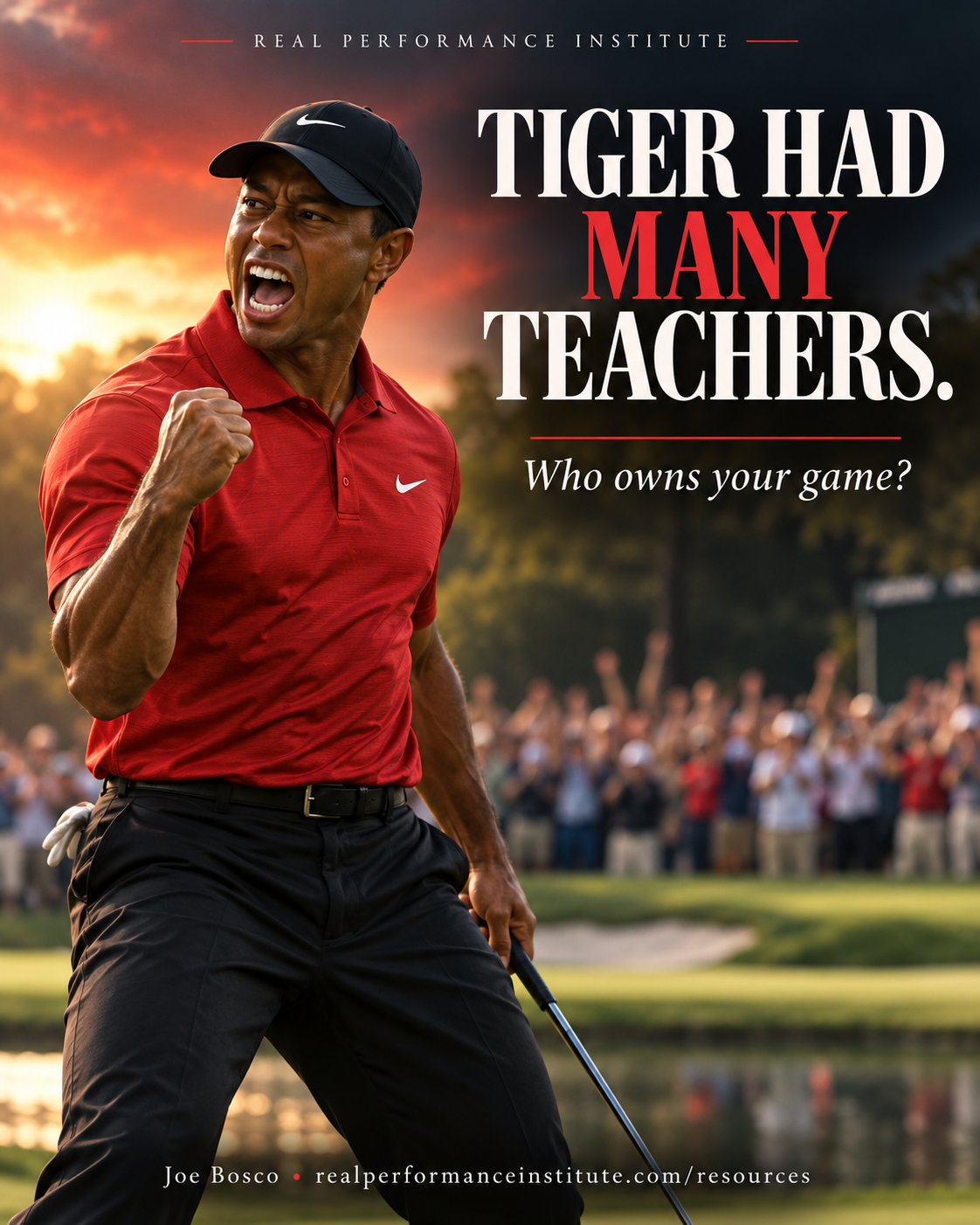
Golf is played one shot at a time, but a golfer is shaped by far more than the person holding the club.
If you are helping an ambitious young golfer—or pursuing that next level yourself—you have probably faced a familiar question:
Do we need a different coach, another specialist, or more time to use what we have already learned?
Tiger Woods’ development offers perspective.
His teachers, family, mental coach, and trusted playing partners contributed in different ways. Their involvement raises a useful question for the rest of us: how do we receive help while continuing to own our development?
We each assemble a way of learning. Some players build around one trusted professional. Others draw from several specialists. Some learn largely through watching, experimenting, and playing.
There is room for all of those paths. What concerns me is when a player either refuses useful help or begins to believe that somebody else holds the entire answer.
A Tapestry of Influences
Tiger’s development included his father, Earl; his mother, Kultida, known as Tida; early instructors Rudy Duran and John Anselmo; psychologist Dr. Jay Brunza; Stanford coach Wally Goodwin; and, across his professional career, Butch Harmon, Hank Haney, Sean Foley, and Chris Como. [1–3]
He also sought specific putting help from Steve Stricker and Matt Killen. Rob McNamara became a trusted second set of eyes on his swing. [4–5]
Those relationships served different purposes, at different times. They should not be treated as interchangeable—or as proof that every change helped.
What they establish is that an extraordinarily accomplished player repeatedly made room for other people’s expertise.
Accepting help and owning your development can coexist.
My connection with Rudy makes this personal. I brought him to teach with me at Greentree Golf Academy at Glencoe Golf Club, and later for an Accenture event at The Glen Club. In our conversations, Rudy described regular playing lessons with young Tiger: going onto the course, solving the shot in front of them, and making the game engaging through ideas such as Tiger Par.
Published histories generally identify Rudy as Tiger’s primary instructor from about ages four to ten, with continued visits and golf afterward. My recollections of our conversations add context to that continuing relationship. [1]
What stayed with me was the emphasis on playing. Here is a situation. What can you do with it? Try something. Notice. Learn.
Tiger’s education also extended beyond swing instruction. In a 2010 interview, he said his mother had taught him meditation over the years. [6]
Brunza’s work as his mental coach is documented. John Andrisani’s Think Like Tiger also describes self-hypnosis in that preparation. The details of their private work should remain attributed to those accounts. [3, 7]
A person’s development can include technical knowledge, emotional skills, attention, imagination, and experience. No single professional has to supply all of it.
What Does “Self-Taught” Mean?
Even the phrase “self-taught” deserves a little care.
Bubba Watson has said he never had a lesson. In the same 2006 interview, he explained that his father taught him the basics when he was young. Those statements can fit together if “lesson” means formal professional instruction. [8]
We do not need to question his honesty to recognize the distinction. Learning happens in more places than the lesson tee. A player can be largely self-directed and still be influenced by other people.
When Help Becomes Dependence
For the player who actively seeks instruction, a different challenge appears: how do you receive help without handing over ownership?
I hear versions of this concern from developing golfers, college players, and players pursuing professional careers: “I need to see somebody else.”
Sometimes they do. A fresh observation can reveal something important. A different specialty may address a need the current relationship does not cover.
But sometimes the search becomes a way to postpone trusting what the player already knows how to do.
“If I could just get to that teacher, everything would be fine.”
That expectation places an unreasonable burden on the teacher and leaves the player feeling dependent on the next appointment.
The timing can make it worse. A player takes a lesson shortly before a tournament, carries a new idea into competition, and then uses the score to decide whether the instruction worked.
A poor round does not, by itself, prove the lesson was wrong. A good round does not prove every change was right. There may have been too little time to understand the adjustment, practice it, or learn how to play with it.
Teachers remain accountable for the clarity, suitability, and timing of their advice. Players remain responsible for asking questions, communicating honestly, and deciding what is ready to travel into competition.
Before making a change, I want the player involved in a few practical questions:
What are we trying to improve?
What should I notice?
How will we evaluate it?
What am I actually taking onto the course?
Multiple sources of help become useful when their roles are clear. Without that clarity, even good advice can become competing instructions.
Who Gets Into Your Bubble?
That brings me to what I call the bubble: the attention you bring to the task in front of you, and what you allow into that space.
A teacher’s contribution may remain with you for years. It can shape your preparation, your understanding, and your confidence. You do not need to replay the whole lesson while standing over the ball.
The work of learning must eventually become something you can use.
A recent video describing Tiger’s preparation brought this into focus for me. The speaker characterized him as seeing the shot, becoming decisive, and then playing it. I cannot independently establish every detail of that account, but the performance principle it prompted is one I teach:
Give yourself time to choose. Once you have chosen, commit.
Decisiveness has its own pace. You can be deliberate and still arrive at a clear decision. If you are unsettled, backing off can be part of that commitment.
Then, when the shot is over, attention has somewhere new to go.
There may be information worth keeping: the wind affected the ball more than expected; the lie changed the strike; you swung without fully committing. Take what is useful. Detailed analysis can often wait until there is time to do it well.
The previous shot does not need to keep occupying the next one.
I think of this as a short memory for judgment and a useful memory for learning.
That applies to good shots, too. Admiring what you have just done, protecting a score, or imagining the finish can pull you away from the present just as surely as frustration.
The invitation is always back to this shot. This situation. This choice.
Many Contributors. Your Next Move.
For teachers and coaches, there is freedom in recognizing that we may be one important voice in a player’s development. Our contribution can matter deeply without becoming the player’s only source of understanding.
For players, there is freedom in receiving that contribution fully while continuing to develop judgment of your own.
Tiger’s career cannot tell us that every coaching decision was wise, or reveal what he privately carried into every shot. It does show that seeking expert help is compatible with extraordinary individual achievement.
Whether you are pursuing golf, leadership, business, or another demanding craft, you can choose your teachers thoughtfully, test what you learn, and build something you can use.
You can welcome many people into your development.
When it is time to act, you still get to own the next move.